I was going through our stacks the other day comparing two copies of the same book, in order to make sure that the book in the best condition was used in a class. Our library books are arranged in Library of Congress call number order for the most part, but we do have some books grouped as collections according to the requests of the original donor.
On this particular occasion I was looking through the shelves of the typography collection which had been assembled by
Edward L. Stone of Roanoke and purchased by the University upon his death. It is a wonderful collection with books that span the history of printing and as a happy accident for me a nice array of period bindings. As I was looking at the books on the shelf, I noticed a Bible
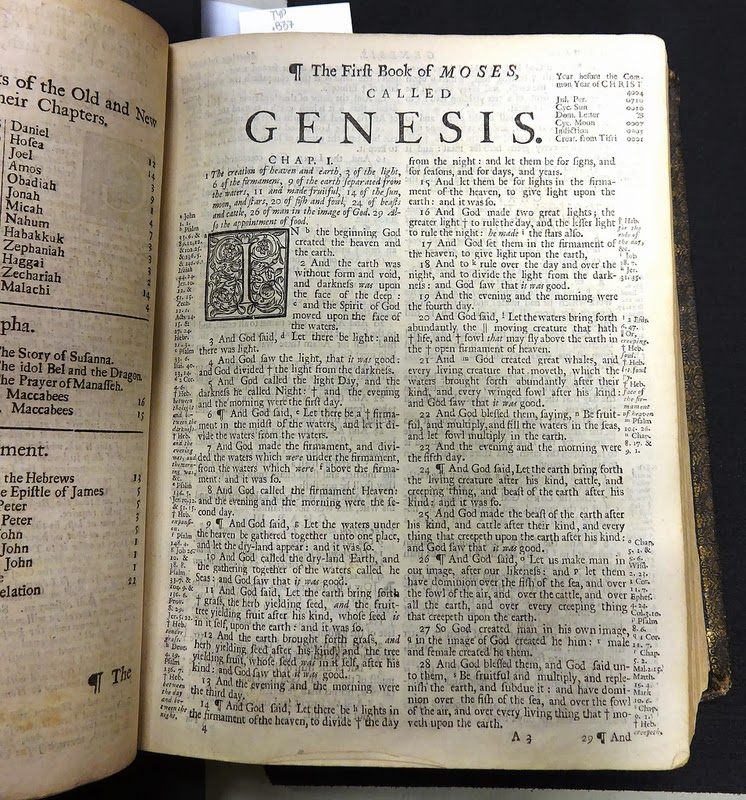
Typ .B37 1717C no.2 with a label on the spine that said "Popham Family". As a fairly common practice, families used to have Bibles that were passed down through the generations, the blank pages at the front and back filled with lists of births, deaths and marriages. I had a classmate from college whose last name was Popham so the spine label caught my eye.
There were two genealogy pages with the usual lists of names and dates, and so I snapped a few pictures and alerted my former classmate to this little coincidence. Thanks to the joys of social media, not only did he chime in, but so did his sister and another friend who is well versed in genealogy. Everyone was very excited and after perusing my photographs, they did conclude that this Bible was indeed owned by their ancestors back in England.
There are no records of this particular Bible prior to its acquisition by the UVa Library, but it is not uncommon for family Bibles to wind up in the hands of book dealers, book collectors and libraries, particularly if the line of the family with the Bible dies out and the other lines have family Bibles of their own.
This particular Bible had been printed by John Baskett in London in 1717 and it is most likely for this reason that the book was purchased by Mr. Stone. Many editions of the Bible are famous for their
typos and Mr. Baskett is famous for printing an edition in which the heading for
chapter 20 of Luke is printed as "parable of the vinegar" when it should be the "parable of the vineyard". This copy is not a "Vinegar Bible" but nonetheless it is a remarkable example of a printed Bible.
 I was going through our stacks the other day comparing two copies of the same book, in order to make sure that the book in the best condition was used in a class. Our library books are arranged in Library of Congress call number order for the most part, but we do have some books grouped as collections according to the requests of the original donor.