Wednesday, October 30, 2013

Library Serendipity

I was going through our stacks the other day comparing two copies of the same book, in order to make sure that the book in the best condition was used in a class.  Our library books are arranged in Library of Congress call number order for the most part, but we do have some books grouped as  collections according to the requests of the original donor.
   
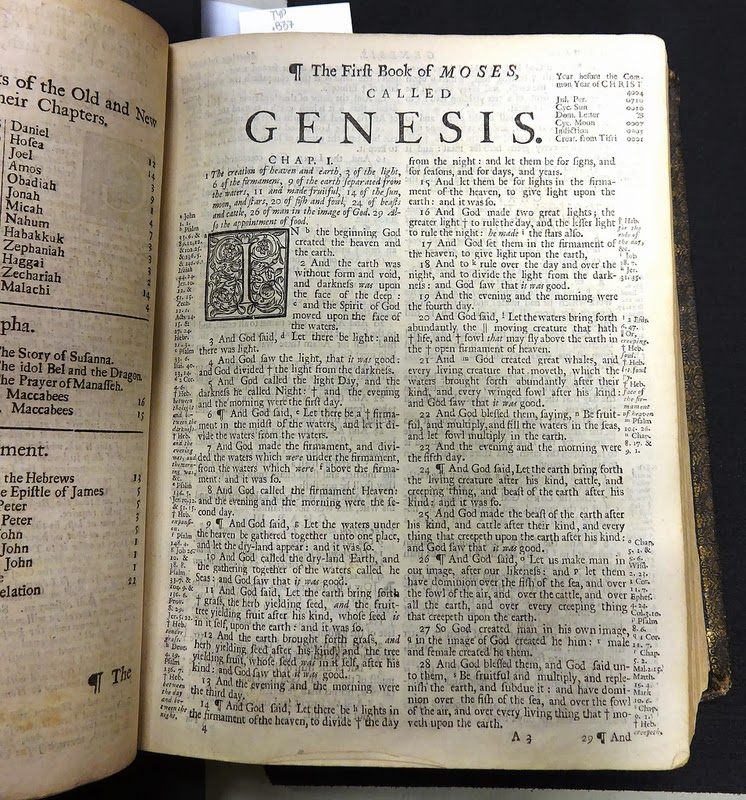
On this particular occasion I was looking through the shelves of the typography collection which had been assembled by Edward L. Stone of  Roanoke and purchased by the University upon his death.  It is a wonderful collection with books that span the history of printing and as a happy accident for me a nice array of period bindings.  As I was looking at the books on the shelf, I noticed a Bible Typ .B37 1717C no.2 with a label on the spine that said "Popham Family".  As a fairly common practice, families used to have Bibles that were passed down through the generations, the blank pages at the front and back filled with lists of births, deaths and marriages.  I had a classmate from college whose last name was Popham so the spine label caught my eye.    

There were two genealogy pages with the usual lists of names and dates, and so I snapped a few pictures and alerted my former classmate to this little coincidence.  Thanks to the joys of social media, not only did he chime in, but so did his sister and another friend who is well versed in genealogy.  Everyone was very excited and after perusing my photographs, they did conclude that this Bible was indeed owned by their ancestors back in England.
There are no records of this particular Bible prior to its acquisition by the UVa Library, but it is not uncommon for family Bibles to wind up in the hands of book dealers, book collectors and libraries, particularly if the line of the family with the Bible dies out and the other lines have family Bibles of their own.


This particular Bible had been printed by John Baskett in London in 1717 and it is most likely for this reason that the book was purchased by Mr. Stone.  Many editions of the Bible are famous for their typos and Mr. Baskett is famous for printing an edition in which the heading for chapter 20 of Luke is printed as "parable of the vinegar" when it should be  the "parable of the vineyard".  This copy is not a "Vinegar Bible" but nonetheless it is a remarkable example of a printed Bible.

Monday, August 12, 2013

Low Relative Humidity- In Pictures!


Conservators spend a lot of time talking about how environmental conditions can affect the overall stability of an artifact.  Our training includes reading many, many articles and case studies that document how fluctuations in temperature and relative humidity (RH) can cause dimensional change in an artifact and increase the rate of chemical decay.  High RH can cause a book to expand and is an even bigger factor when it comes to the chemical reactions that cause paper to degrade.

Low relative humidity is also a concern.  If high RH can cause a book to expand, low RH can case a book to shrink and warp.  Since a book is made of several different component parts that will respond to RH fluctuations at different rates, keeping books and artifacts at a stable RH is crucial.

These facts can be a little abstract and when sharing them with colleagues as I advocate for the care of the Library's collections, it can be difficult to convince people that a book that has survived hundreds of years without environmental control is still susceptible to low RH.  So I was particularly horrified and delighted on a recent cross-country plane flight when I noticed that the book I had brought with me, Maurice Craig's "Dublin 1660-1860" had started to respond to the low RH (10-12% at best) almost two hours into my flight.  Note how the covers have warped away from the body of the text block (pages).  The book had been completely flat when I packed it that morning.  I had been reading it during the flight and only noticed the warping when the flight attendant gave me a cup and I put the book down on the tray table.  I took the picture to make sure I wasn't mis-remembering the condition of the book and resolved to compare it with the condition of the book once I had returned home and the book had a chance to re-adjust to my air-conditioned home in Charlottesville.

My flight had been on Wednesday, August 7th, leaving SFO at 1pm Pacific Time.  The picture at right was taken Friday, August 9th about 8am Eastern Time.  Note how the covers are no longer warping away from the textblock.  Remarkable!

The low relative humidity on the plane is extreme, but it isn't uncommon.  The winter time RH for the Northeastern United States is often in the mid to low teens and collections that are housed in areas that don't have supplemental humidity control are at risk.  Most libraries address the need by keeping their fragile books in boxes.  I was going to return this book, but maybe I will renew it through the winter to see whether we need to make a box.


Tuesday, July 2, 2013

Early TripTik

When I was young and we planned family driving vacations in the old station wagon, my parents often went to the AAA office to get maps and guidebooks and they used to get something called a "TripTik" which was a custom flip map that showed the road we planned to travel.  My parents would give our route (I-95 from DC to Maine, for example) to the person at the AAA office who would then assemble the TripTik page by page and put on a comb binding.  The maps were narrow and only showed the highway and a few features to each side but I thought they had a fun, connect-the-dots aspect to them as the road wound in various directions when you flipped the pages. 

I had always considered them an artifact of the 20th century and family vacations, so I was delighted to see this item in my queue for exhibit review: Survey of the Roads of the United States of America by Christopher Colles. This prospectus was printed in 1789 and in the same format that I remember from my family road trips.  Each page is a separate engraving, showing mileage and local features.   
This close up shows the road to Poughkeepsie, NY and includes some details, such as Wappingers Creek, that are still there today.