Monday, August 1, 2011

Next Up

My next treatment is Palladio's "I quattro libri dell'architettura di Andrea Palladio" which was published in Venice in 1581.  Quite a bit has happened to this book since it first came off the press.  It has had at least four owners judging by the bookplates and inscription on the front paste down and fly leaf.  It has been re-bound at least twice judging from the number of different endpapers attached to the text block; and it has been heavily used for reference given the "thumb stains" on the fore edge margins. There are scribbles of sums on a few of the pages and a few doodles as well.
the four books, dis-bound with their boards
There were several attempts to re-attach the boards with various kinds of tape (all failed).  That said, it is a pretty straight forward treatment.  The binding was in horrible shape, the sewing was broken in several places, the front board was completely detached and many of the pages were broken at the gutter margin.   
So, nothing to do but finish taking the book apart so that it can be cleaned, mended and re-bound.  Once the treatment plan was approved by the Head of Special Collections, I went ahead with the dis-binding, carefully noting where the page numbers had been mis-printed and whether any signature marks or catch words had also been mis-printed. 

Next, dry cleaning to pick up as much loose dirt as possible, and then into the water!  I washed each book separately since there were too many pages to do in one session.  Most of the books needed multiple baths
first bath on the left, second bath on the right


before the paper stopped releasing dirt into the water.  The first bath for this book was at pH 5.5 after a half hour soak which is somewhat acidic, but after three baths the water stayed clear, and then the pages went into a final alkaline bath to impart a little bit of an alkaline reserve in the paper.  It still amazes me how the water changes color so dramatically, and the paper actually looks cleaner and brighter once it dries. 

This book needs to be on exhibit at the end of the month, so stay tuned for more conservation treatment action!!

Monday, June 27, 2011

Step 3


micro_cover3
Originally uploaded by dingbatdc
Smooth leather overall, allow to dry

Step 2


micro_cover2
Originally uploaded by dingbatdc
Wrap turn ins around the board edges

Step 1


micro_cover1
Originally uploaded by dingbatdc
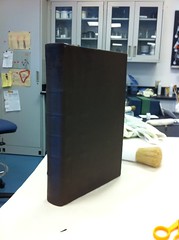
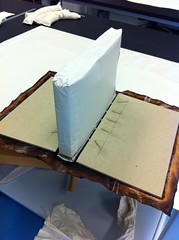
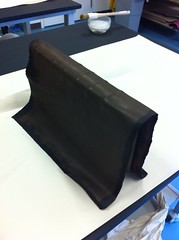
apply pasted out calf hide to spine of book, smoothing over the boards

Monday, June 20, 2011

Arcadia and the shadow of a louse

I saw the play Arcadia the other week.  The setting is the manor house Sidley Park, in two different time periods, 1809-1812 and the present day.  The action of the present day involves two academics and their research to prove theories about what happened at the house in the past.  Hannah Jarvis is researching a person she has named "the Sidley Park Hermit", her belief in his existence is largely based on a drawing of him in the landscape picture book of the manor house grounds.  However, the audience has seen Thomasina Coverly (in 1809) draw the hermit in the book as a joke on the landscape architect Mr. Noakes.

Bernard Nightingale is trying to prove that Lord Byron left England in 1809 because he shot a Mr. Crater (a guest at Sidley Park) in a duel.  Nightingale can place Lord Byron at Sidley Park thanks to a notation in the game book, but he can't prove the Crater connection.  Again the audience has seen "what really happened" in a previous scene and knows the duel was between Crater and Septimus Hodge, Thomasina's tutor and that Crater survived.

Jarvis refuses to publicize her theories until she has proof, while Nightingale goes ahead and lectures on his theory with only the evidence from the game book to back him up. The action of the play eventually reveals that Nightingale's theory is incorrect while Jarvis finds proof of her hermit.

As a conservator, I see a lot of tantalizing clues when I take a book apart.  Watermarks are easier to compare and document when the book is apart and each page can be placed over a light sheet.  Plates can be examined more closely when laid flat on a bench.  I can see many traces of where the binder, printer and perhaps author made choices about a book's production.

For example, the plate of the cheese mites; when I examined it closely, I noticed that the end of the caption over each print had been scraped away, with a teeny bit of printer's ink remaining.  I can't make out what had been printed there, but it is clear that something has been scraped away.  I'm kicking myself now because when I examined the Folger Library's copy of the 1667 edition, I didn't take a picture of the cheese mites plate and now I can't compare the captions.  Could the UVa 1667 copy be a printers proof? based on the cheese mites plate, and the fact the UVa flea plate has some of the reference letters engraved backwards, I'm starting to wonder, and again, I don't have a photo of the flea plate from the Folger copy for reference. 

Which brings me to the shadow of a louse.  Or rather the fact that the UVa plate has a louse that does not cast a shadow and is the only example that I can find of this particular version of the plate.  I examined the Folger 1667 Micrographia and the Chemical Heritage Foundation's 1665 Micrographia and in both books their louse casts a shadow (see the Folger's louse below).  I also sent inquiries to the Smithsonian's Dibner Library regarding their 1665 copy and received word from the Library Company that their copies of the 1745 "Restaurata" edition all had plates with a louse that cast a shadow.

There are other differences in the louse plates and I am extremely grateful to the staff at the various libraries who have helped me pin down the details. 


 While all of this comparison and tracking down of watermarks ultimately did not change the course of conservation treatment for the UVa Micrographia, it has helped me sort though many of the details I noticed during dis-binding.  My notes will be included in my treatment report and available to future researchers who may be able to put those details together with fresh discoveries that finally reveal the true circumstances behind the differences in the two versions of the louse.  For now there is only enough information to ask more questions rather than draw any conclusions, but that is OK because I still have one fascinating book to bind!