Wednesday, November 3, 2010

In Situ

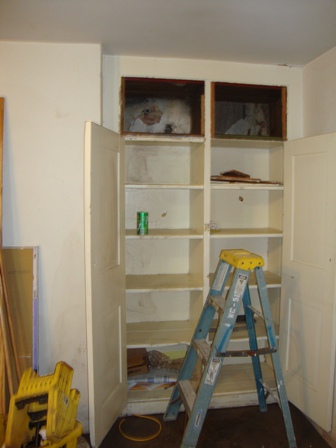
Pavilion IX is undergoing a comprehensive renovation.  The Office of Facilities Management and the Office of the Architect are updating the electrical, heating, cooling and other systems.  In the process of making way for the new, you sometimes find vestiges of the old.  Take a look at this cupboard in the basement of the Pavilion.


Now take a closer look at the top two shelves of the cupboard. What do you see?  The back of the shelves look a little different, they're not painted like the rest of the cupboard.  What's in there?  The Architectural Conservator for the University had some ideas, but asked me to take a look.
The back of the cupboard has wallpaper that just might be original to the building.  A curator that I consulted had this to say: "The wallpaper is an ashlar block design which was very popular during the first half of the 19th century. They were frequently used as dado papers below the chair rail, or in the entry way to suggest solidity and grandeur."  

Since this paper is in the back of a cupboard it might be a scrap that is left over from an installation in another part of the building that no longer survives.  The paper extends behind the frame of the cabinets, so we can only speculate whether it was placed to decorate the back wall of the cabinets or the cabinets were placed over the wallpaper as part of the changing function of the 
room.  

But the plan is to leave the wall paper in place, "in situ" and just mend the torn edges so the remnants don't become more tattered.  Research on the history of the buildings is ongoing and new information is gathered every time a building is renovated or altered.  By leaving the wallpaper in situ, we ensure another opportunity for examination and research that might match up with some other detail about the building that is revealed years down the road.  

Tuesday, October 12, 2010

Collating


Before you take a book apart to clean and mend the pages, re-do the sewing and provide a new binding, you've got to collate it.  Modern books have page numbers to keep everything in order, but back in the good old days, conventions were different; the preface, dedication, introduction might be numbered with lower case Roman numerals or not at all.
the signature is noted with an "A", the catchword corresponds to the first word on the next page


 "And" bottom left corresponds to "And" on the top right
The main text might have page numbers, but more often there would be letters to mark the signatures, and catchwords to help the printer and binder keep everything in order as the book was being printed and assembled.
Plates also add another layer of complexity, sometimes they are numbered sequentially, and sometimes the printer comes up with another system.  In this instance the plate is numbered according to the page it is supposed to be facing, which is a great idea, I just have to make a note as to which page the plate is actually bound with.


Books are made up of many, many moving parts that need to fit together and while page numbers and signature marks may seem like enough to re-assemble all the pieces, it is better to be safe than staring at a pile of sheets and loose plates going hmmm....
do you see the quill from someone cutting a new point?

So, collating, in the conservation context, is a precise documentation of how each page fits into the overall sequence and structure of a book. It can seem a little painstaking to some, but I enjoy it.  It is a great way to commune with a book that I am about to work on, learn something new, and notice all sorts of little details and surprises.

Tuesday, October 5, 2010

up and running!

Remember when the only thing I had in the lab was the fume trunk? my first post!

Well, it's got some company now and I'm busy getting a bunch of posters done for an exhibit on government documents. This poster had a ton of masking tape residue on the back and needed a lot of solvent work to remove it. It will be much better off when it's done and the trunk has been a big help. And I love these benches, I can work on all sides of the poster, round and round mending edge tears.

I find it a little amusing that as a book conservator, my first big show here is all about flat paper, but stay tuned for the next exhibit project, it's a book and I have bought a special nifty tool for the fixing!

Thursday, September 23, 2010

It's nice to have two

We have an exhibit on the 100th anniversary of Government Documents opening in October.  Gov Docs may not seem like a sensational topic, but we have a great collection of posters from World War I to put on display.  And while the images and design are amazing, the posters were not printed on the best paper and have suffered over the years. 

The poster on the right has some big pieces missing or detached, while the poster on the left has tears and plenty of masking tape residue on the back.  Right now, I'm thinking that the one on the left will turn out better, but it is nice to have two.

Tuesday, August 10, 2010

on the road

I do make house calls on occasion and last month I went to the Central State Hospital to help get their archives in order. The collections needed a little help as the staff planned to re-house everything for better storage and since they don't have an archivist or a conservator on staff I was happy to help.


There were many panoramic photographs of graduating classes from the nursing school. Panoramic photographs have a tendency to roll themselves into very tight tubes if they are not stored properly. It is possible to slowly and gently humidify the photos, and when they've relaxed significantly, you can flatten them under blotters and weights.
Using a clear container for your humidity chamber is ideal so you can see what is going on and don't forget about what you have in the chamber. It is a long process, but then you can work on other things while the panoramas take their time.

These photos only needed a little bit of mending. I had brought tissue and methyl cellulose and as it turns out, laptops make nice handy weights, when it is time to dry a mend.

It was a long day, but it is fun to get out and see other collections, help other people and think on your feet!