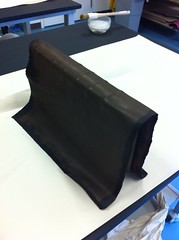
apply pasted out calf hide to spine of book, smoothing over the boards
Monday, June 27, 2011


Monday, June 20, 2011
Arcadia and the shadow of a louse
I saw the play Arcadia the other week. The setting is the manor house Sidley Park, in two different time periods, 1809-1812 and the present day. The action of the present day involves two academics and their research to prove theories about what happened at the house in the past. Hannah Jarvis is researching a person she has named "the Sidley Park Hermit", her belief in his existence is largely based on a drawing of him in the landscape picture book of the manor house grounds. However, the audience has seen Thomasina Coverly (in 1809) draw the hermit in the book as a joke on the landscape architect Mr. Noakes.
Bernard Nightingale is trying to prove that Lord Byron left England in 1809 because he shot a Mr. Crater (a guest at Sidley Park) in a duel. Nightingale can place Lord Byron at Sidley Park thanks to a notation in the game book, but he can't prove the Crater connection. Again the audience has seen "what really happened" in a previous scene and knows the duel was between Crater and Septimus Hodge, Thomasina's tutor and that Crater survived.
Jarvis refuses to publicize her theories until she has proof, while Nightingale goes ahead and lectures on his theory with only the evidence from the game book to back him up. The action of the play eventually reveals that Nightingale's theory is incorrect while Jarvis finds proof of her hermit.
As a conservator, I see a lot of tantalizing clues when I take a book apart. Watermarks are easier to compare and document when the book is apart and each page can be placed over a light sheet. Plates can be examined more closely when laid flat on a bench. I can see many traces of where the binder, printer and perhaps author made choices about a book's production.
For example, the plate of the cheese mites; when I examined it closely, I noticed that the end of the caption over each print had been scraped away, with a teeny bit of printer's ink remaining. I can't make out what had been printed there, but it is clear that something has been scraped away. I'm kicking myself now because when I examined the Folger Library's copy of the 1667 edition, I didn't take a picture of the cheese mites plate and now I can't compare the captions. Could the UVa 1667 copy be a printers proof? based on the cheese mites plate, and the fact the UVa flea plate has some of the reference letters engraved backwards, I'm starting to wonder, and again, I don't have a photo of the flea plate from the Folger copy for reference.

Which brings me to the shadow of a louse. Or rather the fact that the UVa plate has a louse that does not cast a shadow and is the only example that I can find of this particular version of the plate. I examined the Folger 1667 Micrographia and the Chemical Heritage Foundation's 1665 Micrographia and in both books their louse casts a shadow (see the Folger's louse below). I also sent inquiries to the Smithsonian's Dibner Library regarding their 1665 copy and received word from the Library Company that their copies of the 1745 "Restaurata" edition all had plates with a louse that cast a shadow.
There are other differences in the louse plates and I am extremely grateful to the staff at the various libraries who have helped me pin down the details.

Wednesday, May 18, 2011
watermark HIBERNIA

I've got a couple of leads on this paper, but more would be appreciated!
I don't quite know whether knowing the source of endsheet paper will affect the decision making process for treatment, but we have no provenance information related to this book so any information is progress. My first lead, from a colleague at the Dibner Library, told me that the watermark is from Moses Verney who had a mill in Whitechurch Ireland in the later half of the 18th century, which tells me that the remnants of the binding/sewing that I did remove were probably not the original binding of the book.
It's a start!
Tuesday, April 5, 2011
Cheese Mites
The book I'm working on has some amazing and famous engraved plates. Robert Hooke published Micrographia in London in 1665, describing and illustrating his observations made through a microscope.
Here is his illustration for "cheese mites":


Here is his illustration for "cheese mites":
Here is a current picture:
not bad, huh? I had assumed that the critters in the engraving were an out of date name and that modern science had come up with more accurate details, but no cheese mites are for real.
Cheers!
Tuesday, March 22, 2011
Before & After
Conservation of an artifact requires careful documentation
 before and after treatment. Written documentation includes a description of the book and its condition but also the steps and materials involved in the treatment. Photographic documentation supplements the written, showing particular damage as well as other details you may not have noticed during an initial review.
This book had a broken hinge, which means the front cover had become detached from the text block. Portions of the leather spine were also missing.
There are many ways to re-attach a board depending on the structure of the given book, the covering material and the condition of the pieces you have to work with. In this instance, board tacketing was the best option. Tacketing uses linen thread laced through the shoulder of the book and then into the board to re-attach the board. It does not replicate the original method of board attachment, but it is a very strong and subtle method that does not require you to take the book apart or alter the sewing structure in any way.

The other choice I had to make in this treatment was concerning the spine. Should I replace the original with a new piece of leather? Combine the old with new? or stabilize the original?
Stay tuned for the "after treatment" photo!

OK, here's the after treatment photo of the front hinge, demonstrating that the front board has been re-attached. I lined the hinge with a light-weight piece of Japanese tissue and then colored the tissue with colored pencil to blend it into the absolutely gorgeous marbled paper.
 And now for the spine! I decided to go with the last option, stabilization of the original which involved placing a small hinge of Japanese tissue under the front edge of the spine, which allows the spine to flex as the book opens and closes.
The spine is quite narrow so any new leather would have to be very thin and it would have been a tricky thing to attach the original over a new piece. And since I'm not including a photo of the cover in this blog post, you'll have to take my word for it that there's a paper inlay on the cover that would suffer if I tried to lift it to accommodate the thickness of new leather. This is a really beautiful binding, and I did my best to make it structurally sound with minimal impact on the appearance.
A few more words on documentation. Written documentation of conservation treatment is the ethical obligation of all conservation professionals. Photographic documentation is recommended and certainly enhances the written record. Documentation must be archived so that it is available as part of the permanent record of the artifact. This provides an accurate account for future researchers and also gives guidance should the artifact need to undergo further conservation treatment.
My current lab is too small to accommodate a photo documentation area, so I rely on the Digital Services unit located in our special collections library. Digital Services performs the on-demand scanning for the University research community so they are quite a big operation with very high tech equipment, plus a staff who is current on image capture and archiving protocols. I am doing my best to fit into their work flow so that I can take advantage of their equipment and expertise.

This book had a broken hinge, which means the front cover had become detached from the text block. Portions of the leather spine were also missing.
There are many ways to re-attach a board depending on the structure of the given book, the covering material and the condition of the pieces you have to work with. In this instance, board tacketing was the best option. Tacketing uses linen thread laced through the shoulder of the book and then into the board to re-attach the board. It does not replicate the original method of board attachment, but it is a very strong and subtle method that does not require you to take the book apart or alter the sewing structure in any way.

The other choice I had to make in this treatment was concerning the spine. Should I replace the original with a new piece of leather? Combine the old with new? or stabilize the original?
Stay tuned for the "after treatment" photo!

OK, here's the after treatment photo of the front hinge, demonstrating that the front board has been re-attached. I lined the hinge with a light-weight piece of Japanese tissue and then colored the tissue with colored pencil to blend it into the absolutely gorgeous marbled paper.
 And now for the spine! I decided to go with the last option, stabilization of the original which involved placing a small hinge of Japanese tissue under the front edge of the spine, which allows the spine to flex as the book opens and closes.
 The spine is quite narrow so any new leather would have to be very thin and it would have been a tricky thing to attach the original over a new piece. And since I'm not including a photo of the cover in this blog post, you'll have to take my word for it that there's a paper inlay on the cover that would suffer if I tried to lift it to accommodate the thickness of new leather. This is a really beautiful binding, and I did my best to make it structurally sound with minimal impact on the appearance.
A few more words on documentation. Written documentation of conservation treatment is the ethical obligation of all conservation professionals. Photographic documentation is recommended and certainly enhances the written record. Documentation must be archived so that it is available as part of the permanent record of the artifact. This provides an accurate account for future researchers and also gives guidance should the artifact need to undergo further conservation treatment.
My current lab is too small to accommodate a photo documentation area, so I rely on the Digital Services unit located in our special collections library. Digital Services performs the on-demand scanning for the University research community so they are quite a big operation with very high tech equipment, plus a staff who is current on image capture and archiving protocols. I am doing my best to fit into their work flow so that I can take advantage of their equipment and expertise.
Subscribe to:
Posts (Atom)